

Planning ahead is critical to securing funding and advancing projects, but it does not eliminate risk. Even well-planned utility budgets face uncertainty, from equipment failures to revenue shortfalls that put pressure on operations.
In our previous article, we discussed how planning ahead can position your utility to take advantage of funding opportunities. In this edition, we look at how utilities can remain financially resilient when conditions don’t go as planned.
At the core of that resilience are reserves. While often thought of as a safety net or rainy day fund, reserves also help utilities maintain stability, respond to unexpected challenges, and continue providing reliable service.
Types of Utility Reserves
There are three general types of reserves:
- Debt Service Reserves are funds set aside based on the covenants for outstanding debt. These may be tied to individual debt issuances or overall debt load but will be clearly defined in bond documents and should be followed closely.
- Capital Reserves are funds set aside for future large projects or system-wide repair and rehabilitation. We will cover these in a future article, but it can be helpful to think of this as an annual funding target rather than a total balance.
- Operations & Maintenance (O&M) Reserves are cash reserves set aside to provide a cushion when unexpected expenses arise or revenues fall short. These reserves help ensure your utility can continue delivering reliable service in challenging conditions.
While each type of reserve plays an important role, this article focuses on O&M reserves, specifically why, how much, and how to use them. Use this as a guide when discussing reserve levels with policy makers and the public.
Why This Type of Reserve?
O&M reserves support your utility when the unexpected arises. Whether it’s a pump failure requiring replacement, an unusually cold winter leading to more line breaks, or a wet season that reduces water sales, reserves provide the financial flexibility to respond without disrupting service.
They also give staff and policy makers confidence that essential services can continue when conditions do not align with the budget.
How Much to Set Aside?
While O&M reserves are often used for unplanned events, it is still important to have a plan in place. A clear policy should outline how much to maintain, what they cover, and when they are used.
General industry standards suggests maintaining 90 to 365 days of operating expenses, depending on your system’s needs. In some cases, more recent guidance extends that range to up to two years of operating expenses.

So how do you determine what is right for your utility?
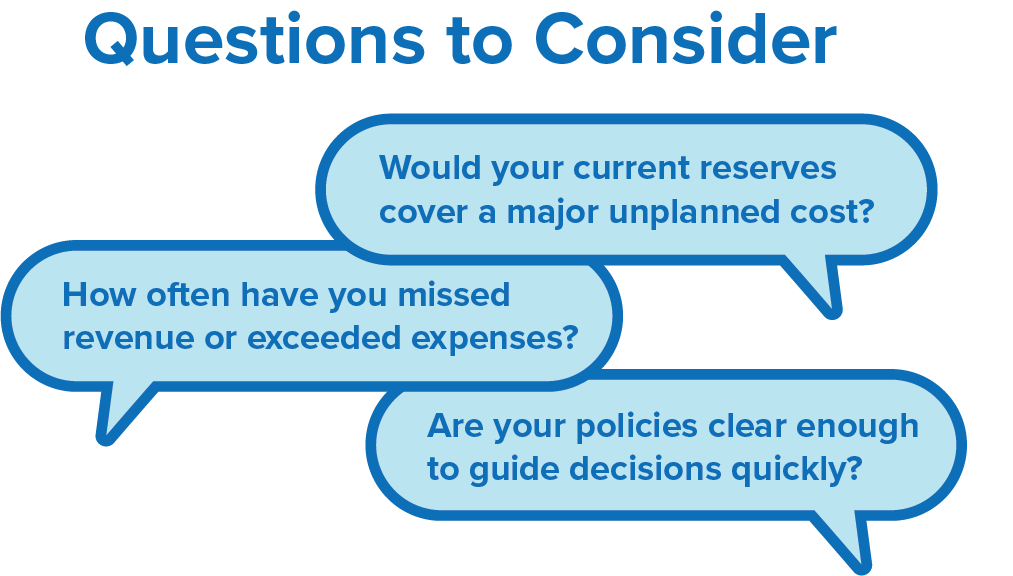
A good starting point is reviewing your last three budget years:
- How often did you miss revenue targets?
- How often did expenses exceed what was budgeted?
- Did those conditions result in a deficit?
If this has occurred more than once or twice, it may be worth targeting 180 to 270 days of operating expenses, rather than the minimum. Ultimately, the right amount should reflect the level of variability and risk your system experiences.
How to Use Them?
Just as important as how much you set aside is defining what those reserves are intended to cover.
For example:
- Are they limited to emergency maintenance?
- Can they be used when utility costs, such as electricity, exceed budget?
- Are they intended to stabilize revenue shortfalls?
Generally, O&M reserves are intended for unexpected situations, rather than planned capital expenses. If a project bid comes in higher than expected, it may be more appropriate to explore other funding options or reserve types. Clear policies should also define when reserves are used. This helps decision-makers determine when to draw on reserves versus adjusting elsewhere in the budget.
These policies may include guidelines such as:
- Using reserves when costs exceed a defined percentage of the budget
- Covering revenue shortfalls beyond a certain threshold
- Using reserves only after other cost-saving measures have been exhausted
Having these guidelines in place ensures consistent and transparent use of reserves. Building and maintaining O&M reserves gives your utility the stability and flexibility to manage unexpected challenges without disrupting service. Planning supports future investment, while reserves provide the flexibility to respond when costs or conditions shift. Together, they help create a more resilient system that can maintain reliable service and adapt to future needs.
As you develop or refine your reserve policies, we’re available to help think through what works best for your system. Whether you have a specific scenario in mind or want to test an approach, we’re always open to sharing insights and serving as a sounding board. You are welcome to reach out to Ryan Graf, AE2S Nexus Senior Consultant, if you have questions.