

Are You Using the Right Inflation Index?
During budget season, one of the biggest challenges for utility managers is forecasting future costs. Many organizations rely on the federal inflation rate based on the Consumer Price Index (CPI). While that approach is common, it may not provide the most accurate picture of future utility expenditures.
Looking Beyond the CPI
The CPI measures changes in the prices consumers pay for everyday goods and services such as housing, food, transportation, and healthcare. It is an excellent indicator of changes in the cost of living and is widely used to adjust wages, pensions, and Social Security benefits. However, CPI was designed to measure consumer spending, not the costs associated with building, operating, repairing, and maintaining utility infrastructure.
Utilities generally experience higher inflation because of labor, materials, equipment, and contractor issues. Over the past decade, these costs have frequently grown faster than the general inflation rate. Applying CPI to these items often results in underestimating future project costs.
Breaking utility costs into major categories and assigning an inflation index to each is considered a best practice for long-term financial planning. Instead of applying a single inflation rate to every expense, each cost category is escalated using an index that most closely reflects the market forces affecting that expense. A practical approach would be to use three to five primary escalation rates:
- Labor – Employment Cost Index (ECI) (HR or Finance normally handles this)
- Chemicals – Chemical-specific Producer Price Index PPIs
- Energy – Electric Power PPI or contractual power escalation
- Capital Construction – ENR Construction Cost Index (CCI) or Building Cost Index (BCI)
- General Administrative Costs – CPI-U
Below is a commonly used framework:
| COST CATEGORY | RECOMMENDED INDEX | WHY |
| Labor | Employment Cost Index (ECI) or regional wage data | Tracks wages and benefits better than CPI. Public utilities often compare this with negotiated union agreements or municipal salary surveys. |
| Chemicals | Producer Price Index (PPI) for Industrial Chemicals or specific chemical PPIs (chlorine, caustic soda, aluminum sulfate, polymers, etc.) | Chemical prices are heavily influenced by energy markets and global supply chains and can fluctuate far more than CPI. |
| Electric Power / Purchased Power | PPI – Electric Power Generation, Transmission and Distribution or utility contract escalation | Reflects changes in wholesale electricity costs better than general inflation. |
| Fuel | Energy Information Administration (EIA) fuel forecasts or fuel-specific PPIs | Fuel prices can be highly volatile and are not well represented by CPI. |
| Capital Construction | ENR Construction Cost Index (CCI), Building Cost Index (BCI), or FHWA construction indexes | Captures increases in construction labor and materials for infrastructure projects. |
| Heavy Equipment | PPI for Construction Machinery and Heavy Equipment | Better reflects replacement costs for loaders, excavators, and similar assets. |
| Pipes, Valves, Pumps, Electrical Equipment | Relevant PPIs for each equipment category | Tracks manufacturer pricing more accurately than construction indexes. |
| Professional Services | Employment Cost Index or engineering fee trends | Engineering and consulting costs are driven primarily by labor. |
| General Office Expenses | CPI-U | Appropriate for office supplies and routine administrative purchases. |
The challenge with using the above matrix is the amount of time and effort it takes to find and forecast the future for each category or type of infrastructure. However, this approach provides a more defensible financial forecast and aligns closely with asset management and full-cost pricing principles. It also makes it easier to explain to elected officials and finance directors why certain budget categories – particularly capital, chemicals, and labor – may rise faster than the overall inflation rate.
Where to Find the Indices
The Producer Price Index (PPI) measures price inflation for individual products or industries. Its data is published by the U.S. Bureau of Labor Statistics and measures prices at the wholesale/producer level with a focus on manufacturing, commodities, materials, equipment, and services. A limitation of the PPI is that it does not account for labor shortages, contractor availability, or project delivery costs.
Two of the most widely recognized measures are the Engineering News-Record (ENR) Construction Cost Index (CCI) and the Building Cost Index (BCI). The CCI tracks changes in the cost of construction by measuring common labor wages along with the prices of structural steel, Portland cement, and lumber across 20 major U.S. cities. The BCI uses the same material costs but substitutes skilled labor for common labor, making it particularly useful for building construction. Because these indexes are based on the materials and labor that drive infrastructure projects, they more closely reflect the costs utilities actually experience for capital projects.
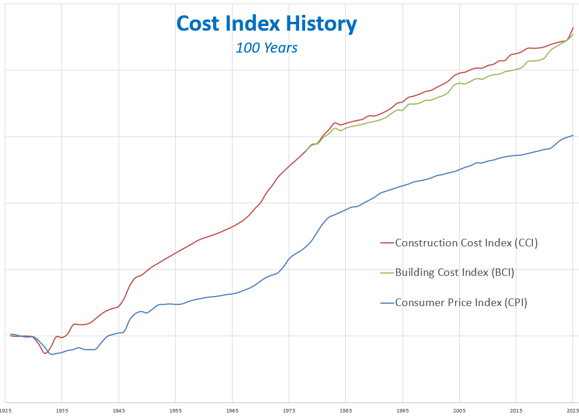
The CCI and BCI have been averaging just over 1% more than the CPI the past five to 20 years. During periods of supply chain disruptions, labor shortages, and material price volatility, the gap between consumer inflation and construction inflation has been as much as ten times the CPI. Again, utilities that continue to forecast capital and infrastructure costs using only CPI may significantly underestimate future expenditures, resulting in underfunded capital improvement programs, inadequate reserve contributions, and rate plans that fail to keep pace with the true cost of maintaining and replacing critical infrastructure. Over time, this can leave utilities falling behind on asset renewal, increasing financial risk, and making future rate adjustments more difficult for customers to absorb.
Using the appropriate inflation index can significantly improve long-term financial planning. Capital improvement plans, asset replacement forecasts, and multi-year operating budgets all benefit from cost projections that are tied to construction market conditions rather than consumer spending trends.
The next time you are preparing your utility budget, ask yourself: Are you forecasting tomorrow’s infrastructure costs with a consumer price index or with an index that reflects the work you actually do? Choosing the right inflation measure can lead to more realistic budgets, better capital planning, and fewer financial surprises. Reach out to Jon Eaton, AE2S Nexus Senior Consultant, if you’d like additional information about future cost estimating.